Material Selection for CCS applications
Nippon Steel developed a comprehensive material selection chart for CCS applications, based on extensive experimental investigations under supercritical CO₂ environments containing various types and concentrations of impurities.
The material selection chart, which covers a wide range of operating conditions relevant to CCS wells, explicitly accounting for:
- CO₂ phase conditions
- Impurity effects
- Chloride concentration in formation water
Key experimental findings have been published in international technical conferences such as AMPP and Eurocorr (e.g. C2026-00140 'Material Selection Investigation of Corrosion Resistant Alloys for CCS Applications')
Material selection chart for CCS applications
Material applicability is evaluated under 2 different formation water conditions, defined as:
- Moderate salinity: 5 wt% NaCl (< 31,300 mg/L Cl⁻)
- High salinity: 25 wt% NaCl (< 181,000 mg/L Cl⁻)
The material selection chart enables rapid screening of suitable materials based on the combined effects of:
- Impurity concentration (O₂, SO₂, NO₂, H₂S)
- Chloride level
- Pressure and temperature conditions
This approach allows early‑stage down-hole material screening while maintaining sufficient conservatism for CCS‑specific risks.
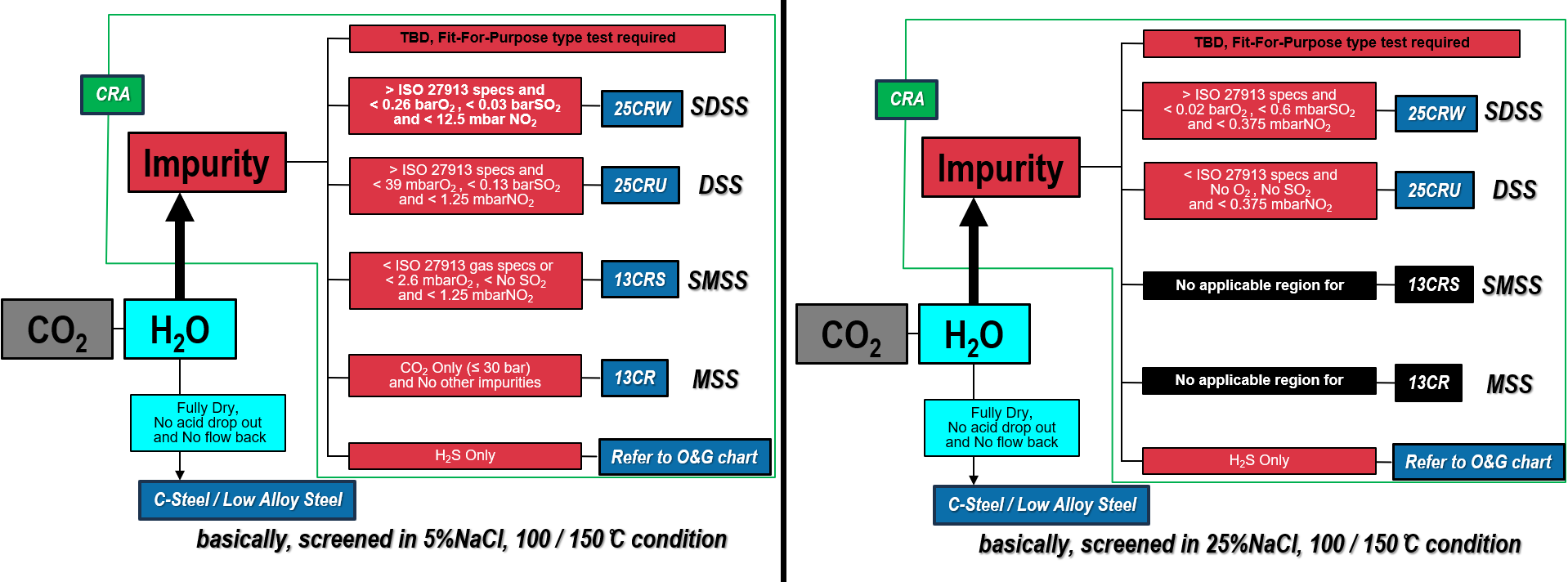 Fig 1: 5% NaCl (< 31,300 mg/L Cl) condition Fig 2: 25% NaCl (<181,000 mg/L Cl) condition
- note - ISO27913: 2024 Table A.1 - Example of a gaseous phase CO2 stream specification - (O2, NOx, SOx : ≤ 10 ppm mol, H2S: ≤ 5 ppm mol)
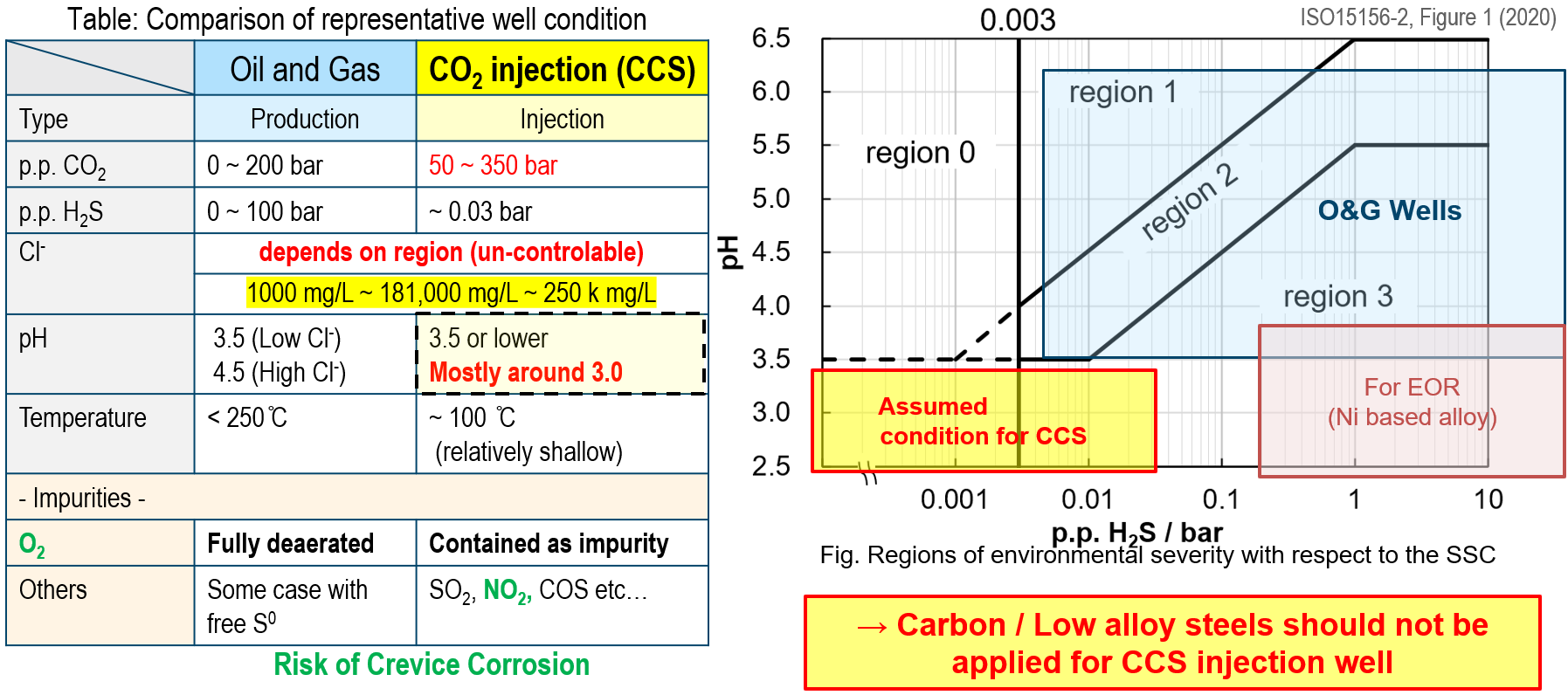
New corrosion risks inherent to CO2 injection wells
Compared to conventional hydrocarbon production wells, CO₂ injection wells are exposed to fundamentally different corrosion mechanisms, such as:
- Formation water flow back into the wellbore
- Strong acidification due to CO₂ dissolution (pH around 3.0~3.5)
- Presence of oxidizing and acid-forming impurities (O₂, SOx, NOx)
- Increased susceptibility to localized corrosion (pitting / crevice)
👉 These factors significantly increase the complexity of material selection, making conventional oil & gas approach for CCS applications..
Required Input Data for CCS Material Selection
The following information must be considered to properly assess the corrosiveness of the environment:
1. Injection conditions
- Pressure and temperature profile
- Injection and shut‑in sequences
2. Injection fluid composition
- CO₂, H2O, H2S, O2, NOx, SOx and any other element considered important
3. Reservoir fluid composition
・Formation water composition (especially, Chloride contents [Cl-], bicarbonate contents [HCO3-])
・Original Reservoir Gas composition in case of injection in a depleted reservoir
Material Selection Analysis for your wells
Nippon Steel provides customized material selection analyses tailored to individual CCS well conditions.
Based on the supplied input data, we will:
- Evaluate corrosion risks under realistic CCS environments
- Identify applicable material grades based on available test data
- Optimize material selection from both technical and economic perspectives
- Propose fit-for-purpose (FFP) testing when needed
Please fill in the following spreadsheet and contact us:<https://nipponsteel.box.com/s/4xawkhleq4dlmd574krd6xy3pi66g46t>
Key design considerations for CCS Materials
(1) Low pH (typically 3.5 or lower) caused by dissolved CO2:
- Increased general corrosion rates
- Enhanced risk of localized corrosion (pitting / crevice) leading to potential environmental cracking
- Dedign well life span which may be extended 50 years or more.
(2) Effect of Oxygen (O₂)
- Corrosion rate increases with O₂ partial pressure
- Pitting and crevice corrosion are promoted even at relatively low concentrations
(2) Effect of SO₂ / NO₂
- Trace amounts of SO₂ (~ppm level) significantly increase localized corrosion severity
(3) Chloride Effect (Critical Parameter)
- Corrosion susceptibility is strongly dependent upon chloride concentration
- High chloride environments drastically reduce the applicability range of lower-grade CRAs
👉 Therefore, material selection for CCS applications must be based on comprehensive, data-driven approach, rather than conventional oil & gas practices.
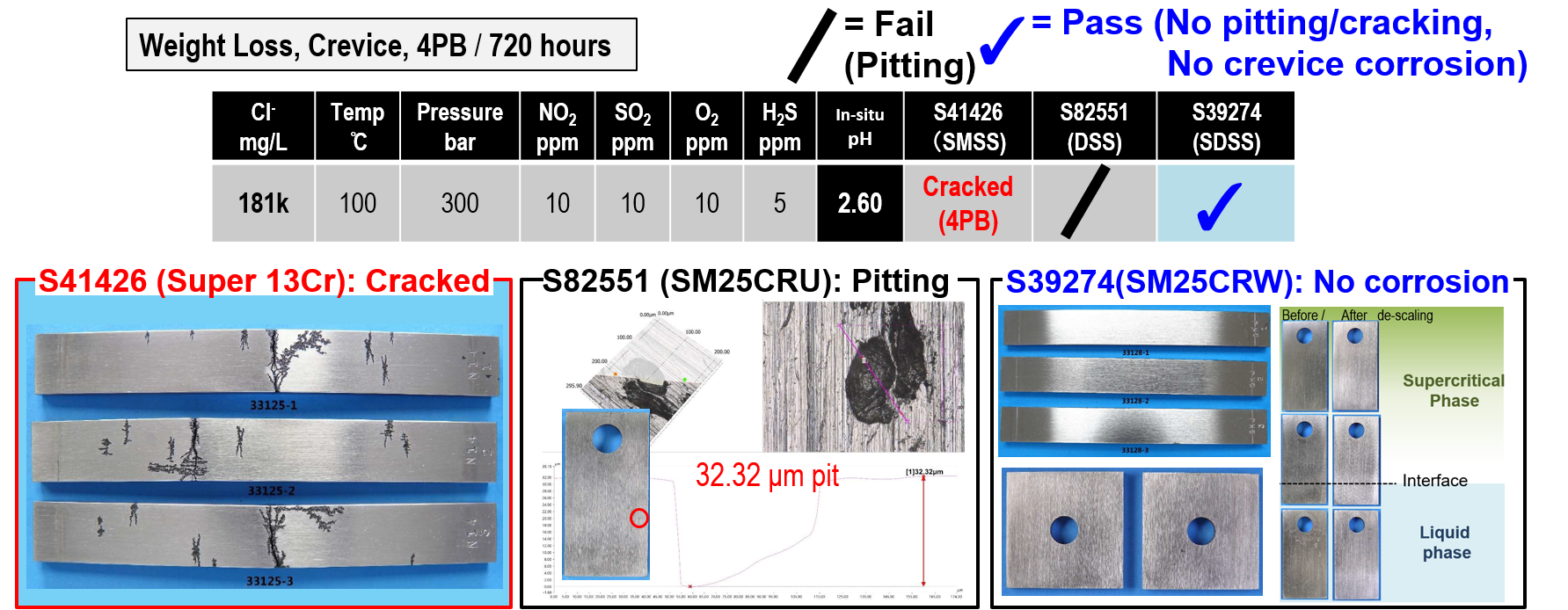
The below data provides some examples of the recent studies performed by Nippon Steel about the effect of O2 , SO2 and NO2 in CO2 dominant environments; materials tested include Super Martensitic Stainless Steel (SM13CRS / UNS S41426), Propietary-Cost effective Duplex Stainless Steel (SM25CRU / UNS S82551) and Super Duplex Stainless Steel (SM25CRW /UNS S39274) (see below Figure, just an exapmles)
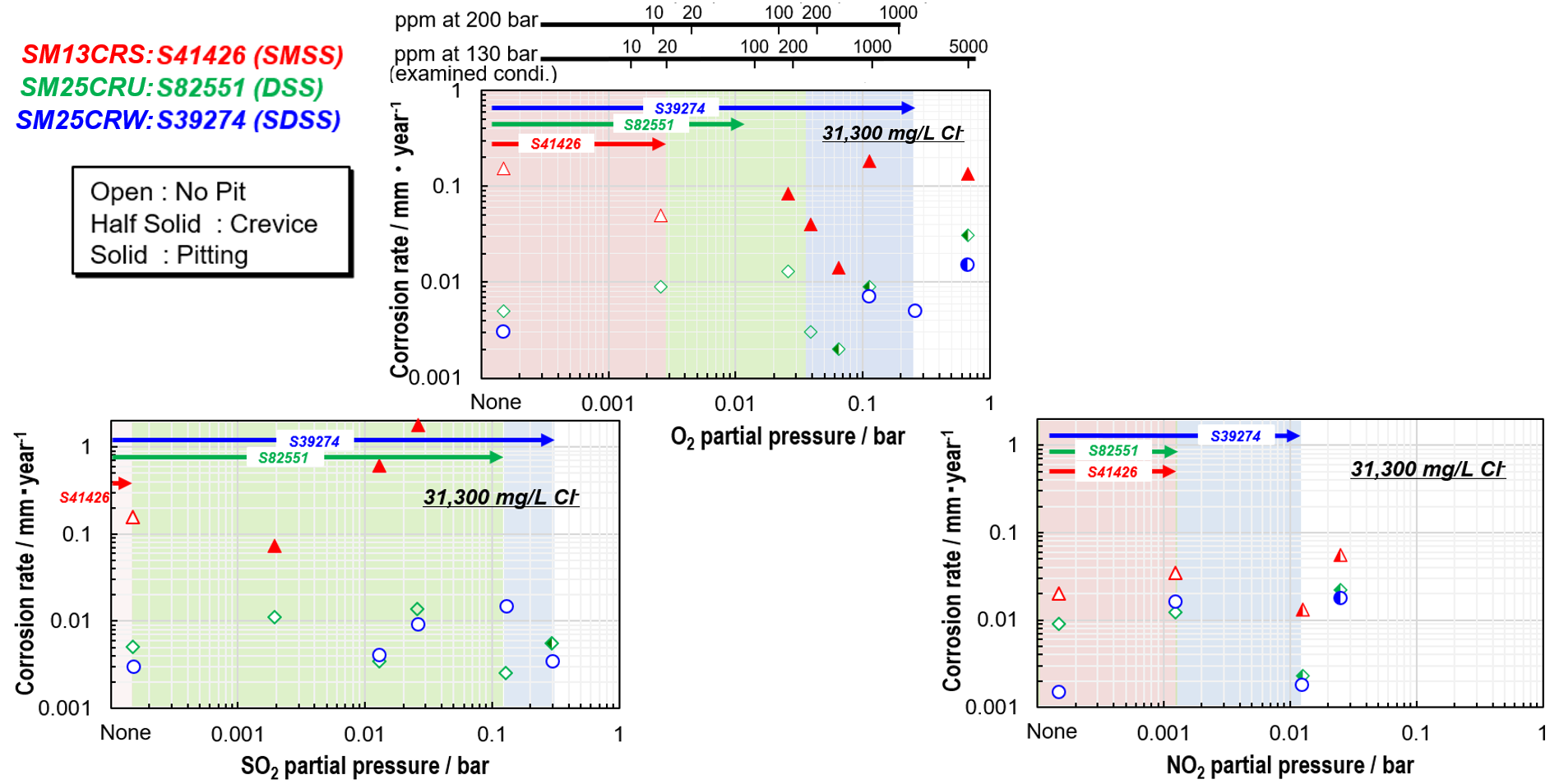
Concerning NOx, SOx impact on materials integrity, additional studies are required to define the critical thresholds of these impurities on materials behaviors in CO2 dominant environments.
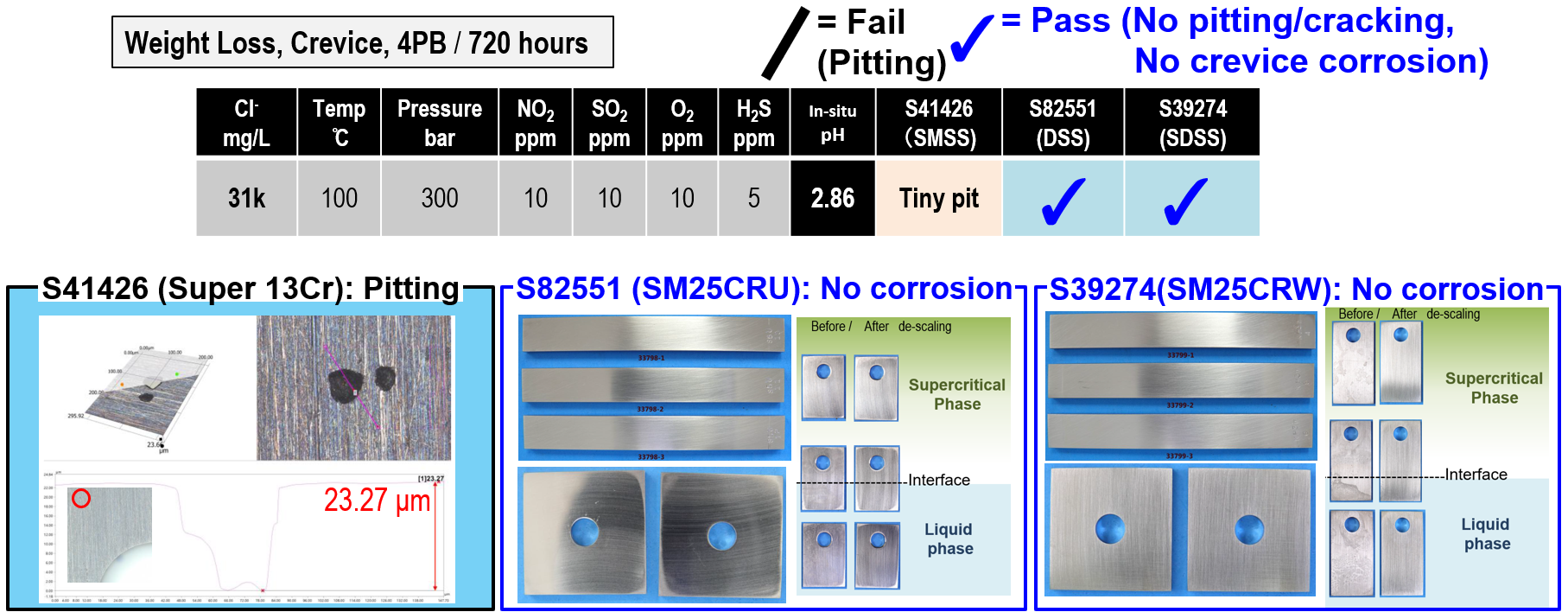
Effect of Mixed Gas Conditions
Testing under simulated CCS gas compositions (including O₂, SO₂, NO₂, H₂S) revealed:
- Materials corrosion performance is highly sensitive to combined impurity effects
- Duplex Stainless Steels (DSS) may be applicable under:
- Low impurity concentration as indicated in ISO 27913
- Super Duplex Stainless Steels (SDSS) maintains robust corrosion resistance performance under severe environments
Low-Temperature material Integrity (Joule–Thomson Effect)
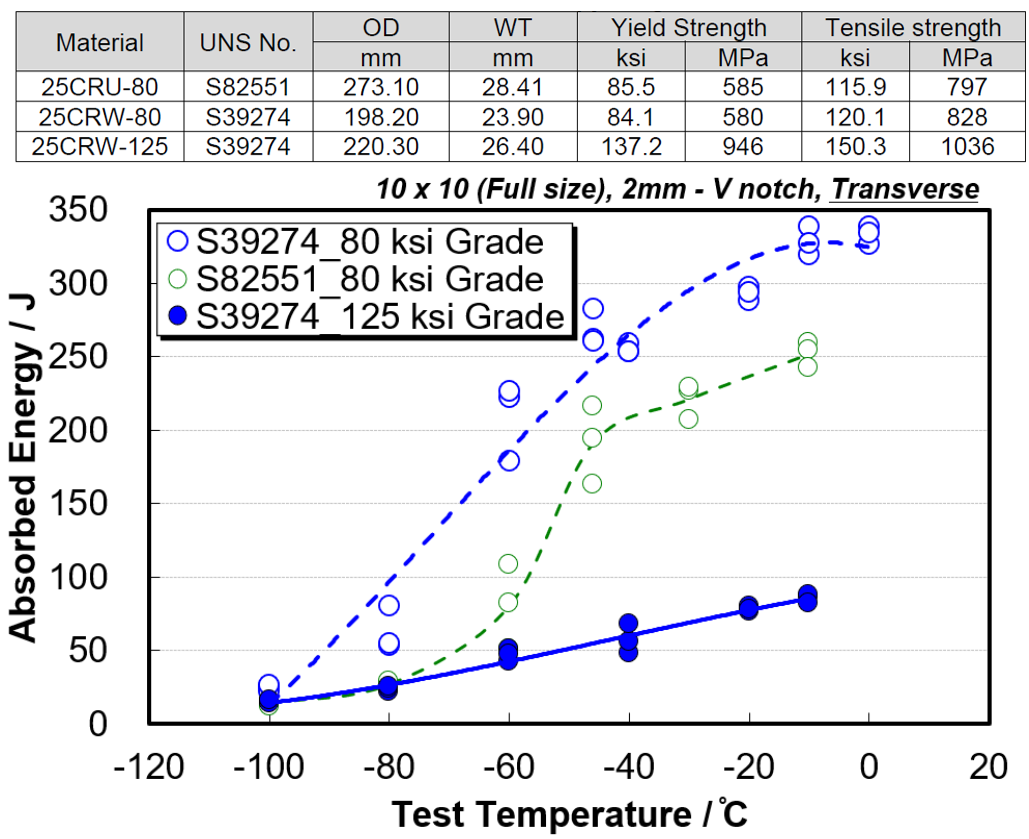
Accidental depressurization of high-pressure CO₂ causes rapid temperature drop down to cryogenic levels due to the Joule–Thomson effect.
Charpy impact testing results indicate:
- Solution-annealed DSS and SDSS maintain sufficient toughness down to low temperatures
- Cold-worked SDSS shows reduced toughness
For further information, Please contact us: Contact Us Built: May 2026 | K. Kanki